
The Forest Is Fed Here
Salon of the Mythweaver

The forest had learned etiquette before it learned mercy.
I knew this by the way the clearing held itself. Not wild, not ruined, but arranged. The trees leaned inward as if listening. Brambles braided themselves into low arches. Moss crept with deliberation, not hunger, upholstering what remained of civility. The air carried the sour sweetness of rot restrained by custom.
The table waited.
It was long and narrow, set for eight, though only six chairs remained upright. The others had softened into the soil, their legs swallowed slowly, reverently, as if the earth had learned patience from watching people dine. Porcelain lay where it had been placed, no cup overturned, no saucer cracked beyond repair. Time had not been kind, but it had been precise.
The silver had blackened into a dull, funereal shine. Teacups bloomed with lichen. A teapot sat at the head, its spout choked with ivy, its lid sealed by a wasp’s nest long since abandoned. Everything here suggested interruption, not abandonment.
This had not been left.
It had been paused.
I stepped closer, and the ground sighed. Leaves compressed underfoot with the sound of old paper. My boots sank slightly into loam that smelled of damp wool and iron. I had dressed as one does for calling, black coat, linen cuffs, hair tied back with a ribbon already greying at the edges. The century demanded its uniform, even here.
The tablecloth had once been white. Now it carried the color of old teeth. Roots stitched through it from below, threading linen and soil together, as if the forest had taken up embroidery to pass the years.
I touched a chair. It was still warm.
The setting bore names, etched shallowly into the wood. Not titles, not surnames. Christian names only. The intimacy of it unsettled me. Each place setting carried the faint outline of use, a depression in the seat, a stain on the cloth where tea had been spilled and wiped and spilled again.
This was a sentence that had not been finished.
I understood then that the gathering had occurred. That something had been spoken here which could not be taken back. A promise perhaps. Or a refusal. The kind that stains the air long after the voice has gone quiet.
The forest had listened.
The forest had remembered.
I sat.
The chair accepted me with a soft complaint, wood bending like bone. Vines shifted at my ankles, exploratory. Somewhere beneath the table, something wet adjusted its bulk.
The teapot trembled when I lifted it. Inside, the tea had thickened beyond liquid, dark and fragrant, smelling of crushed leaves and copper. When I poured, it did not steam. It breathed.
The sound carried. Cups chimed faintly as if answering one another. Leaves rustled closer. The forest leaned in, manners impeccable.
I drank.
It coated my mouth, bitter and sweet, heavy as oil. I felt it descend through me, warm and instructive. My stomach clenched, not in refusal, but recognition. This was not nourishment. This was communion.
The table responded.
Roots broke the surface of the soil and curled along the legs, tightening. Moss climbed my boots, my calves, the hem of my coat. The chair beneath me softened further, its back rising, reshaping itself to my spine. Wood pressed into flesh. Flesh answered.
I tried to stand and found that standing was no longer the point.
Across from me, one of the empty chairs creaked. Its seat dipped, as if remembering a body that had once occupied it. I smelled something old and human beneath the green. The forest had eaten before. It had learned what to keep.
I poured again. The ritual demanded completion. The tea wanted witnesses, even if it had to make them.
My hands slowed. Fingers stiffened. Bark crept along my wrists, splitting skin without blood. Pain arrived late and politely, like an afterthought. I felt myself rooting, not downward, but outward, awareness spreading along the table’s length, into the cups, into the cloth, into the waiting chairs.
I was eating, yes.
Leaves steeped in marrow. Sap thick with history. The aftertaste of every mouth that had opened here before me. But the table was feeding too, drawing from me in increments so small they felt ceremonial. It did not rush. It never does. It has learned that panic spoils the offering.
My limbs grew heavy with purpose. The chair’s arms tightened, not restraining but measuring, testing how much of me could be kept without collapse. Beneath the cloth, roots threaded through my thighs, binding muscle to grain, vein to varnish. I felt my heat siphoned upward, absorbed into the polished surface where countless elbows had once rested.
This was not consumption.
This was conversion.
The forest received me through the table. That was the covenant. The table was not furniture. It was a mouth trained to smile. A relic built to civilize the act of being taken. Each cup, each plate, each place setting existed to disguise the hunger beneath with ritual and linen.
When the last swallow was complete, I understood the stillness, why no one screamed. Why the chairs never fled. Movement would have been impolite.
I could no longer turn my head. My spine had been corrected into something useful. Bark sealed the seams of my skin. My breath slowed until it matched the pace of the woods, long and subterranean. I remained aware, preserved for witness, for instruction.
The table remembered me immediately.
That is why the chairs remain, why the settings are never disturbed. Why time falters here, circling like a hesitant guest. This place does not kill. It recruits.
Someone will come. They will mistake the quiet for abandonment. They will read the order as an invitation.
The table will open its patience. The forest will lean closer.
And I will hold my position, polished by moss, ribs hidden beneath linen, ready to receive the next name.
Still.
Set.
Already fed.
This Mythological, lyrical fiction piece was prompted by the brilliant Labyrinthia Mythweaver
🕯️ Salon of the Mythweaver 🕯️
Welcome to the first gathering.
Each Sunday, I will offer an image—a doorway, a fragment, a place caught in time—a corner of the Labyrinth.
Your task is simple: step through.
This week’s image is an overgrown tea table in the woods. The chairs remain. The table is set. Time has not been kind.
What happened here?
You may choose the century. You may choose the genre. You may choose whether this is memory, myth, romance, horror, satire, science fiction—or something stranger.
Perhaps the guests never arrived. Perhaps they never left. Perhaps the forest grew around them while they were still speaking.
There are no rules beyond this: follow the thread that pulls at you.
Short or long. Tender or feral. Beautiful or grotesque.
Tag your piece so I can find it. Drop the link in my subscriber chat under the weekly thread. Everyone is welcome.
I will wander through the Salon and read.
The table is waiting.
As always, the best story earns my eternal admiration. 🥀
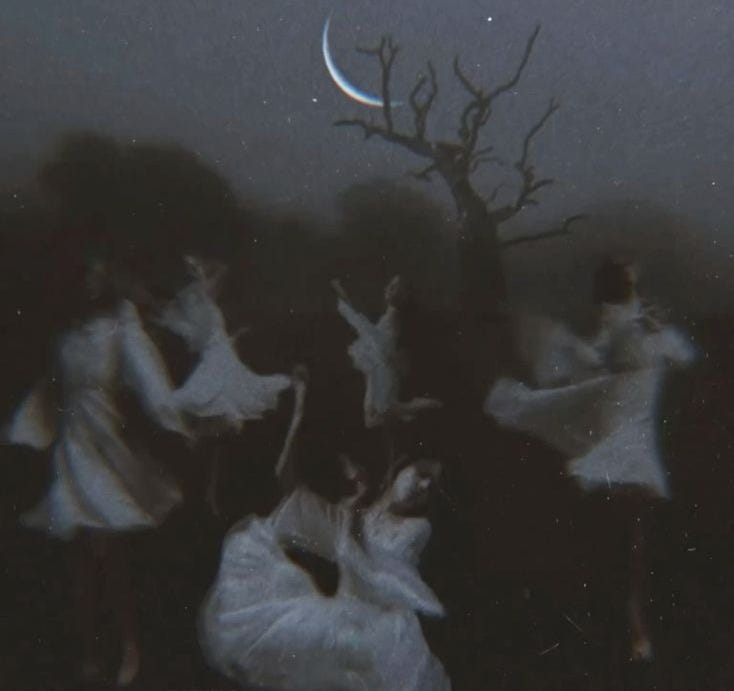
Creepy. Joined them.
Ooooof.
Absolutely excellent. Great work!