
Escapism

This escapist lyrical piece is a response to Labyrinthia Mythweaver Salon of the Mythweaver prompt.
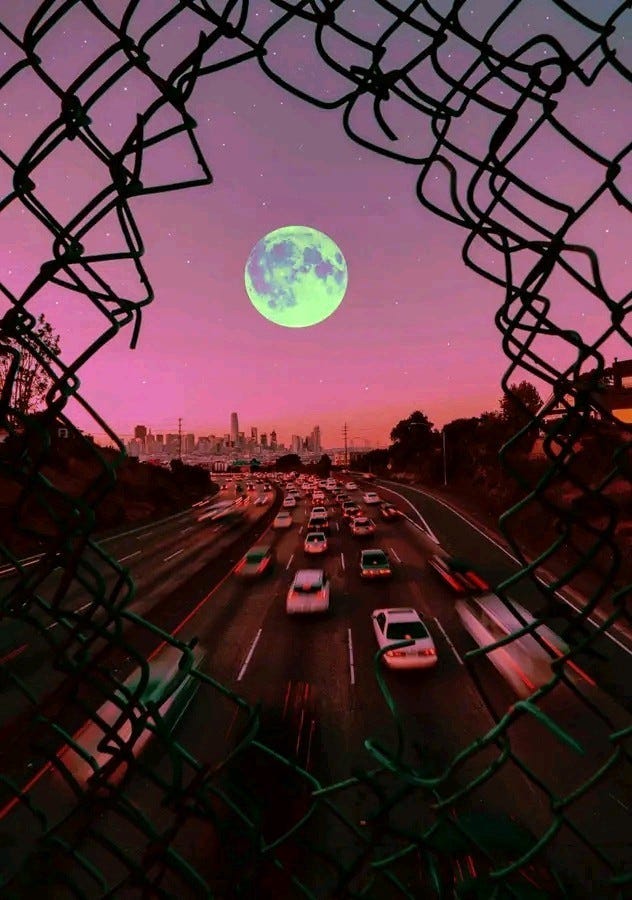
The fence is the first truth: dark green wire pulled tight as a net over breath, its diamonds rust-bitten, its patience exhausted. Someone has torn a hole through it, a jagged mouth of metal teeth. Through that wound the city spills outward like a fever dream, electric twilight, amethyst bleeding into bruised rose. It looks almost holy at this distance. Almost merciful.
The highway runs straight through the middle of it all, a river of engines carrying the faithful toward their daily devotions. Cars blur into streaks of red and white, arterial light pulsing through the mechanical body of the night. The whole thing moves with the urgency of blood refusing stillness, a circulation of wanting: more speed, more brightness, more proof that motion is the same thing as living. Above it hangs the moon, swollen and impossible, green as poisoned milk. It glows with a radioactive patience, casting its strange gospel over glass towers and restless lanes. The city kneels to it without noticing.
From the cage, everything looks beautiful.
That is the cleverness of it. The magentas, the soft pink haze clinging to the horizon like a bruise learning to bloom. The skyline rising like a cathedral of clean ambition. Even the stars seem domesticated here, faint and polite behind the neon breath of the streets. It is a world designed to dazzle the eye while quietly disciplining the soul. You are meant to believe the road is freedom. You are meant to run with the traffic, let your pulse synchronize with the engine’s growl, your hunger shaped neatly by the promise of arrival.
But the road is only a leash made of distance.
Stand long enough at the wound in the fence, and you begin to feel the lie unravel inside your bones. The speed of the city has a smell to it; burnt rubber, warm metal, the faint chemical sweetness of something always overheating. Even the light feels rehearsed, like a smile held too long. The traffic rushes forward with religious obedience, but no one ever leaves the circle. They simply move faster inside it.
Turn away from the hole in the wire, and the air changes.
At first, it is only a difference in breath. The electric hum fades, replaced by the low patience of earth keeping its own time. The soil carries a darker perfume: wet bark, crushed leaves, the deep mineral sweetness that rises after rain. Petrichor, the old word for the earth remembering itself. It slips into the lungs like a quiet absolution.
Here, the ground is not polished smooth for speed. It swells and dips underfoot, roots pressing up through the dirt like old knuckles refusing burial. The trees stand with the solemn confidence of creatures that have never needed applause. Oak first, then cedar, their trunks ribbed with age, bark breathing out the resinous warmth of sap and sunlight long stored. When the wind moves through them, it does not hurry. It lingers. It carries the green smell of needles and the slow sweetness of decay, the honest perfume of things returning to themselves.
In the dark under the branches, time loosens its collar.
No traffic screams for attention here. No neon insists you become something brighter, thinner, louder than your own pulse. Instead, there is the quiet architecture of roots threading through the soil, a whole hidden kingdom working patiently beneath the surface. They braid around stones, cradle pockets of water, share their silent messages in the dark. A forest is not a crowd but a communion.
The body begins to remember its first language.
You feel it in the way your breath deepens, how the ribs widen like doors opening after a long winter. The skin cools. The mind, so long trained to chase the next flashing promise, begins to settle into the slow grammar of leaf and shadow. Here, nothing begs to be extraordinary. Moss grows without announcement. Ferns unfold their green fists toward the dim light. Even the fallen trees are not failures but thresholds, their hollow trunks filling quietly with mushrooms and soft loam.
Behind you, the city still burns in its neon halo, that poisonous moon hanging low like a fluorescent god. The highway continues its endless sermon of speed. But the forest does not argue with it. It simply waits, breathing its deep cedar breath, holding the darker truth inside its roots: that escape was never the road rushing forward in blinding lines of light.
Escape was always the earth
patient, green, and breathing
waiting just beyond the fence.
Poetic prose with great imagery. Thank you. <3
I loved the way you turned the city and the forest into two completely different truths — one dazzling and restless, the other patient and real. The final lines stayed with me most; they feel like a quiet revelation. Beautiful, atmospheric writing.